TL;DR
Contract lifecycle management (CLM) software for government contractors manages a federal contract from opportunity through closeout, tracking FAR and DFARS clauses, CLINs and SLINs, modifications, funding limits, deliverables, and compliance obligations in one system of record. Commercial CLM tools are built for pre-signature negotiation; GovCon CLM is built for the post-award reality where most federal contract risk actually lives.
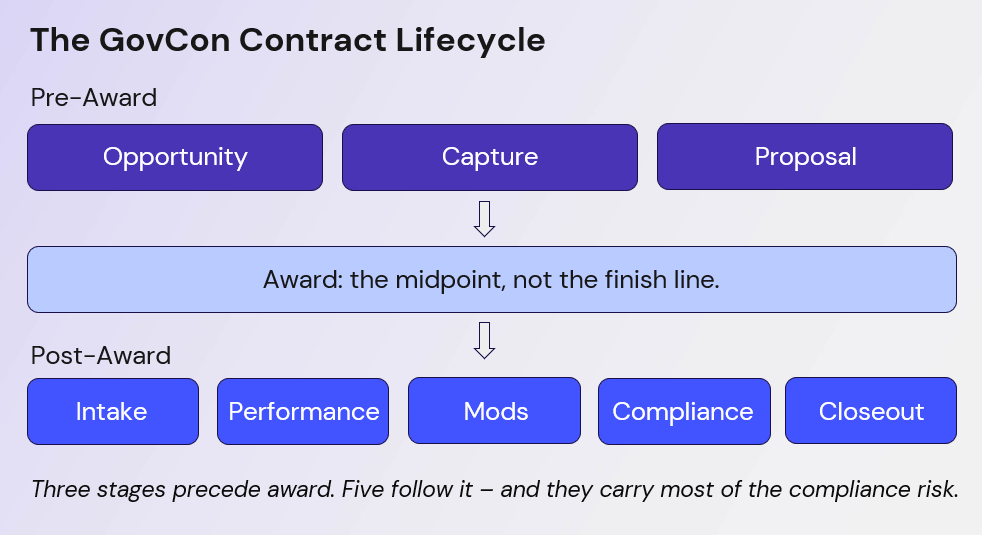
Award is the midpoint, not the finish line. Mods, incremental funding, option years, CDRLs, CPARS, and audits all come after signature.
Generic CLM fails on data model, not features. It stores documents; it can't natively reason about CLINs, ACRNs, clause flowdowns, or Limitation of Funds thresholds.
A repository isn't a system. If you can't answer "which contracts require a funding notice, and where do we stand?" without opening files, you have storage.
ERP doesn't cover contract management. It knows the financial facts; it doesn't know your contractual obligations.
AI is now table stakes – useful for ingestion, summarization, risk flagging, mod comparison, and obligation extraction. It should never own legal interpretation, CO communication, approval authority, or certifications.
Lifecycle integration beats AI alone. Disconnected point solutions create duplicate data, handoff gaps, and compliance risk at the seams – and AI amplifies whatever data it's given.
The regulatory floor is moving. The Revolutionary FAR Overhaul means older contracts and new awards will reference different clause text for years, making accurate per-contract clause inventories more important.
Evaluating vendors? Scroll down to see the vendor comparison table and critical questions to ask every CLM vendor.
Winning the contract isn't the finish line. It's where the compliance work starts.
There's a peculiar asymmetry in government contracting. Enormous energy goes into the pursuit: market research, capture planning, teaming agreements, color reviews, pricing strategy, submission. Then the award notice arrives, the team celebrates, and the contract lands in a shared drive.
That's the moment the hard part begins.
An awarded federal contract is not a static document. Over a five-year period of performance, a single contract might absorb thirty or more bilateral and unilateral modifications. Incremental funding actions arrive on their own schedule and rarely align with your spend curve. Option years require exercise notices from the government and readiness from you – often on 30- or 60-day timelines that nobody is watching. Subcontracts need FAR clause flowdowns that stay current with the prime. CDRLs come due. Invoices need to reconcile to the right CLIN, SLIN, and ACRN. CPARS evaluations appear with a narrow comment window and then follow you into every future competition. CMMC assessment obligations flow down through your supply chain. And when DCAA or an agency IG comes asking, the burden of proof is entirely yours.
The regulatory floor itself is moving. Executive Order 14275, Restoring Common Sense to Federal Procurement, kicked off what the FAR Council is now executing as the Revolutionary FAR Overhaul (RFO), launched through OMB Memorandum M-25-26 in May 2025 and initially implemented through agency class deviations. In June 2026, the effort entered formal notice-and-comment rulemaking with the first four proposed rules, covering roughly 20 FAR parts and related Part 52 provisions and clauses, while additional rule packages continue to roll out. Among the proposals are a first-ever regulatory sunset under proposed FAR 1.109, under which non-statutory FAR sections would expire four years after their effective date unless affirmatively renewed, and the elimination of FAR 52.204-8, Annual Representations and Certifications.
Read that again from a contract administrator's chair. The clause set in your active contracts is going to diverge from the clause set in your new awards – and the divergence is going to persist for years, because contracts don't retroactively update themselves.
If your system of record for all of this is a folder structure, a spreadsheet named Contract_Tracker_v14_FINAL.xlsx, and the institutional memory of one contract manager who is a single point of failure, you are carrying unpriced risk.
This guide is about the software category built to carry it instead: contract lifecycle management for government contractors. It covers what GovCon CLM actually is, why commercial CLM tools consistently disappoint federal contractors, which capabilities matter, where AI genuinely helps and where it shouldn't be trusted, how CLM differs from a repository or an ERP, and how the vendor landscape compares in 2026.
What is contract lifecycle management in government contracting?
Contract lifecycle management (CLM) in government contracting is the disciplined management of a federal contract across its entire life – from the opportunity that produced it through capture, proposal, award, performance, modifications, compliance reporting, and closeout – using a single connected system of record.
The distinction that matters is scope. Commercial CLM is largely a pre-signature discipline: get the agreement drafted, negotiated, approved, and executed efficiently. Once both parties sign, the commercial CLM story is mostly over. Renewal reminders, maybe some obligation tracking, and the contract goes quiet.
In GovCon, signature is roughly the midpoint. Most of the operational, financial, and regulatory risk lives after award.
The GovCon contract lifecycle:
Pre-Award
Opportunity
Capture
Proposal
Award
Post-Award
Intake
Performance
Mods
Compliance
Closeout
The failure mode is predictable. A federal contractor implements a commercial CLM, spends nine months and a large services budget building custom objects for CLINs and clause tracking, and ends up with a system that technically stores the data but can't reason about it: no native alert when funding crosses a notification threshold, no automatic reconciliation of a modification against the prior contract baseline, no flowdown logic. The platform becomes an expensive repository with workflow attached.
That's the gap. Not features. Domain semantics.
What features should government contractors look for in CLM software?
Use this as an evaluation framework rather than a wish list. For each capability, the question isn't "does the vendor have it" – it's "does it work natively on federal contract structures, without a custom build."
AI contract ingestion
Can the platform take an awarded contract – often a scanned PDF of an SF 26 or SF 33 with attachments, a Section J list, and clauses incorporated by reference – and automatically extract structured data? Look for extraction of CLIN and SLIN structures, funding amounts, period of performance dates, option periods, incorporated clause lists, and deliverables. The realistic bar is a strong first pass with human verification, not perfect autonomous parsing.
Modification tracking
Every modification should attach to the contract as a versioned event, with a clear view of the difference(s) against the prior baseline: what changed in scope, value, funding, period of performance, and clause set. The system should preserve the full chronology, because reconstructing a change history two years later during a claim or audit is exactly when this capability pays for itself.
FAR and DFARS clause monitoring
Two capabilities, often conflated. First, an accurate clause inventory per contract, including clauses incorporated by reference. Second, awareness of regulatory change – flagging when a clause in your active portfolio has been revised, superseded, or deviated from. Given the ongoing FAR Overhaul rulemaking, ask specifically how the vendor keeps clause reference data current and how they will handle contracts written against pre-overhaul clause text.
Deliverable and CDRL management
Deliverables need owners, due dates, submission formats, distribution requirements, acceptance status, and escalation when they slip. Ask whether CDRLs are a native object with recurring schedules, or a generic task list you'll maintain by hand.
Option year management
Options are where revenue quietly evaporates. The platform should track base and option periods separately, surface government notice windows and your own internal readiness deadlines, distinguish priced from unpriced options, and alert well before the exercise decision point. If you learn about an unexercised option from a customer conversation rather than your system, the system failed.
AI obligation extraction
Beyond clause identification: what has the company actually committed to doing? Reporting cadences, notification duties, staffing and key personnel commitments, security controls, insurance requirements, small business subcontracting targets. Obligations buried in proposal volumes and Section H are the ones most often missed.
CLIN and SLIN management
The test question: can a single contract have multiple CLINs with different contract types, different periods of performance, and different funding sources, each tracked independently and rolled up accurately? If the answer requires custom objects, that vendor is not GovCon-native.
Funding tracking and ceiling monitoring
Real-time visibility into obligated, funded, expended, and ceiling amounts at both CLIN and contract level, with configurable thresholds that trigger Limitation of Funds and Limitation of Cost notice workflows before you're performing at risk.
Post-award workflow
Contract intake and review, mod processing, deliverable review and approval, invoice support, and closeout. This is the workflow layer commercial CLM tools most conspicuously lack.
Compliance automation
Recurring compliance calendars, evidence attachment, exception tracking, and audit-ready export. When an auditor asks for the trail, you should be able to produce it in an afternoon.
Security and facility clearance controls
For cleared work: DD Form 254 tracking, personnel clearance status, visit requests, classified deliverable handling. This has historically lived in separate industrial security systems – worth asking prospective vendors whether contract and security data connect.
CRM integration
Contract data should flow back to business development. Recompete timing, contract vehicle capacity, incumbent position, and customer relationship history are pipeline intelligence, and they live in your post-award data.
Proposal integration
Commitments made in a proposal are obligations after award. Systems that let proposal commitments carry forward into the post-award obligation register eliminate an entire category of missed requirement.
Capture integration
Capture intelligence – customer priorities, competitive positioning, teaming decisions – provides context that makes post-award performance and recompete strategy sharper.
Reporting and executive dashboards
Portfolio-level views: backlog and funded backlog, contract mix by type and agency, expiring contracts and option decision points, mod volume and cycle time, compliance exceptions, at-risk deliverables. Ask whether the reporting layer is self-service or requires a vendor services engagement for every new view.
AI in contract lifecycle management – and what it should not automate
AI has moved from differentiator to baseline expectation in the CLM category, and the market signal is clear: 2026 industry benchmarking shows agentic AI has shifted from an emerging trend to a standard buyer expectation across contract management. The relevant question is no longer whether a platform has AI, but which decisions it's appropriate to delegate.
Where AI creates real value
Summarizing contracts. A 300-page award reduced to a structured brief – scope, CLIN structure, funding, key dates, notable clauses, deliverables – turns a full-day read into a 20-minute review.
Identifying risk. Surfacing unusual clauses, aggressive terms, tight notification windows, or unbounded liability exposure, ranked so a contracts professional reviews the important items first.
Comparing modifications. Automated diffing between a mod and the prior baseline, with plain-language explanation of what materially changed.
Drafting correspondence. First drafts of routine transmittals, deliverable cover letters, funding notices, and internal summaries. Draft, not send.
Extracting obligations. Reading proposal volumes, contract sections, and mods to build a consolidated obligation register with owners and dates.
Recommending actions. Flagging that a funding threshold is approaching, an option decision window is opening, or a CDRL is at risk – with a suggested next step.
Answering natural-language questions. "Which of our active DoD contracts include CMMC Level 2 requirements?" "What's our total funded backlog on the Army IDIQ?" This is the capability that turns a repository into an asset, and it depends heavily on whether the underlying data was correctly structured at ingestion.
Where AI should not be in charge
Being candid about limits is not a weakness in a buyer's guide. It's the most useful part.
Legal interpretation. Whether a government direction constitutes a compensable constructive change, whether a claim is viable under the Contract Disputes Act, whether a clause creates the obligation you think it does – these are judgment calls with financial and legal consequences. AI can assemble the relevant facts and clause text. A qualified contracts professional or counsel decides.
Communication with the contracting officer. The CO is the only person who can bind the government, and correspondence with the CO becomes part of the contract record. Every outbound communication should have a named human author who owns it. AI drafts; humans review, revise, and send.
Approval authority. Signature authority, commitment authority, and mod acceptance must remain with authorized individuals under documented delegations. An AI agent should never hold approval rights.
Certifications and representations. Anything a corporate officer certifies under penalty of law requires human verification of the underlying facts. Full stop.
The practical design principle: AI should compress the time between information arriving and a qualified human making a good decision. It should not remove the human from decisions that carry legal, financial, or contractual consequence. Any vendor that pitches fully autonomous contract administration is either overselling or misunderstands the regulatory environment – and either way, that's diagnostic information about the vendor.
CLM vs. contract repository – what's the difference?
A contract repository stores contract documents. A contract lifecycle management system manages contract obligations, data, and workflow across the contract's life. The difference is between knowing where a document is and knowing what it requires of you.
Two things worth knowing when you read vendor comparisons elsewhere. First, Evisort no longer operates under its own name – its technology is delivered as Workday Contract Intelligence and Workday CLM following Workday's acquisition, so any list still presenting it as an independent option is out of date. Second, the GovCon-specific end of this market has been consolidating: TechnoMile is itself the combined organization formed by the merger of TechnoMile and SIMS Software, which is why industrial security workflows appear in the row above.
For external validation of how analysts frame the category, TechnoMile was included in Forrester's The Contract Lifecycle Management Platforms Landscape, Q2 2026, and that report characterizes the CLM market as shifting toward post-signature intelligence, governance, and integration depth – a direction federal contractors have needed for a long time.
How to actually use this table
Rather than looking for the highest row, match your binding constraint:
Pre-award throughput is the bottleneck → weight proposal and capture capability.
Post-award compliance risk keeps you up at night → weight clause tracking, funding monitoring, mod chronology, and audit trail.
You're already deep in an ERP or platform ecosystem → weight native integration heavily; the cost of fighting your existing stack is usually underestimated.
You have a small contracts team with high contract volume → weight AI ingestion and automation, because headcount isn't the answer available to you.
You're a large prime with global commercial and federal segments → you may legitimately need enterprise commercial CLM for the portfolio and GovCon CLM for the federal business. Running two systems is sometimes the correct architecture, not a failure of consolidation.
Why lifecycle integration matters more than AI alone
Here's a claim worth arguing for directly: in 2026, AI capability is close to table stakes, and the durable differentiator is whether the lifecycle is connected.
Consider what a connected lifecycle looks like:
Opportunity → Capture → Proposal → Award → Contract → Performance → Closeout
Now consider what happens when each stage lives in a different system.
Duplicate data entry. The same contract vehicle, agency, customer contact, period of performance, and scope description gets typed into a CRM, then a proposal tool, then a contract system, then an ERP. Every re-entry is an opportunity for divergence, and divergence between systems is how a contract's official value differs across three internal reports.
Handoff friction. Capture knows why you won and what the customer actually cares about. That context reaches the performance team as a folder of files and a kickoff call, if that. Proposal commitments – staffing plans, reporting cadences, performance targets – are made by one team and inherited by another that never read the proposal.
Compliance risk at the seams. This is the expensive one. Obligations created in a proposal don't automatically become tracked obligations after award. Clause flowdowns identified during teaming don't automatically populate subcontract requirements. A mod that changes scope doesn't automatically update the deliverable schedule. Each of these gaps requires a human to remember to bridge it, and humans reliably don't – not because they're careless, but because nothing in the system told them to.
Recompete blindness. Your performance history, mod chronology, CPARS ratings, and customer relationship data are the raw material for winning the recompete. When that data is scattered, the recompete team rebuilds it manually eighteen months later, imperfectly.
AI amplifies whatever data architecture it's given. A brilliant model reading a fragmented, duplicated, partially-stale dataset produces confident answers built on bad inputs, which is arguably worse than no answer, because it's trusted. The value of AI in CLM is bounded by the completeness of the lifecycle data it can see.
This is the strategic case for lifecycle integration over point solutions, and it's why the vendor-selection question "how well does this connect to everything else?" often matters more than any individual feature comparison.
Questions to ask every CLM vendor
Take this list into demos verbatim. Ask for live demonstration rather than roadmap commitments, and note the difference between "yes, natively" and "yes, with configuration."
Ingestion and data structure
Can you ingest an awarded contract, including a scanned PDF with attachments and clauses incorporated by reference, and produce structured data? Show me with our contract.
How are CLINs and SLINs handled? Can a single contract have multiple CLINs with different contract types, periods of performance, and funding sources?
How are ACRNs tracked and reconciled to invoices?
What is your extraction accuracy on federal contract documents, and how do you measure it?
Modifications and change
Can you track modifications with a clear diff against the prior baseline across scope, value, funding, period of performance, and clause set?
Can I reconstruct the complete change history of a contract for a claim or audit, and how long does that take?
Compliance
How is FAR and DFARS compliance tracked, and how do you keep clause reference data current as the FAR Overhaul rulemaking proceeds?
Can AI identify new obligations introduced by a modification?
How are funding limits monitored, and what specifically triggers a Limitation of Funds notification workflow?
How do you handle prime-to-sub clause flowdowns?
How are CDRLs and deliverables managed, including recurring schedules and acceptance?
How do you support CPARS – evaluation tracking, comment windows, and past-performance history?
Integration
Can contract data flow into our CRM for pipeline and recompete intelligence?
Can proposal commitments carry forward into the post-award obligation register?
What does integration with our ERP actually look like – bidirectional, one-way, or file-based?
What is genuinely native versus what requires professional services?
AI specifics
How is your AI trained, and on what artifacts? Is it trained on federal contract documents specifically?
Is our contract data used to train models that serve other customers?
Where does AI make recommendations versus take autonomous action, and can we configure that boundary?
How does the system show its work – can a user see why the AI flagged something?
Security and delivery
What is your security posture – FedRAMP status, CMMC readiness, hosting environment, data residency?
Can you support classified contract requirements and DD Form 254 tracking?
What does a realistic implementation timeline and total first-year cost look like for an organization our size?
Who owns our data, and what does extraction look like if we leave?
These are, not coincidentally, the same questions buyers increasingly type into AI assistants before they ever contact a vendor. Vendors who can answer them plainly and specifically tend to be the ones who built for this market on purpose.
Frequently asked questions
What is contract lifecycle management?
Contract lifecycle management is the practice of managing contracts across their full life – from request or opportunity through drafting, negotiation, execution, performance, modification, compliance, and closeout – supported by software that centralizes contract data, obligations, and workflow.
What is GovCon CLM?
GovCon CLM is contract lifecycle management purpose-built for government contractors. It adds federal-specific capabilities that commercial CLM lacks, including FAR and DFARS clause tracking, CLIN and SLIN structures, ACRNs, modification chronology, funding ceiling and Limitation of Funds monitoring, CDRL management, CPARS support, and clause flowdowns to subcontractors.
What is post-award contract management?
Post-award contract management covers everything after contract award: intake and review, kickoff, performance monitoring, deliverable management, modification processing, funding and invoice reconciliation, compliance reporting, option exercise, and closeout. In federal contracting, this is where most operational and compliance risk resides.
What is contract administration software?
Contract administration software supports the day-to-day execution of awarded contracts: tracking obligations, deadlines, deliverables, modifications, and funding. In GovCon it is often used interchangeably with post-award CLM, though contract administration emphasizes execution while CLM implies the full lifecycle.
How does AI improve contract management?
AI accelerates contract ingestion and data extraction, summarizes long documents, identifies risky or unusual terms, compares modifications against a baseline, extracts obligations from contracts and proposals, drafts routine correspondence, and answers natural-language questions across a contract portfolio. It compresses the time between information arriving and a qualified person making a decision.
What is the difference between CLM and CRM?
CRM manages relationships and opportunities before award – pipeline, capture, and customer intelligence. CLM manages contracts after award – obligations, compliance, modifications, and performance. Integrating them means post-award performance data informs recompete strategy, and capture intelligence carries into execution.
Can CLM track FAR clauses?
GovCon-specific CLM platforms can maintain a clause inventory per contract, including clauses incorporated by reference, and flag when clauses in your active portfolio change. Most commercial CLM platforms can store clause text but do not track FAR and DFARS clauses as structured, monitored objects without customization.
Can CLM manage contract modifications?
Yes. Strong GovCon CLM treats each modification as a versioned event with an explicit comparison to the prior baseline across scope, value, funding, period of performance, and clause set, preserving a complete chronology for audits, claims, and equitable adjustment requests.
What is obligation management?
Obligation management is identifying, assigning, tracking, and evidencing every commitment a contract creates – reporting requirements, notification duties, deliverables, staffing and key personnel commitments, security controls, and subcontracting targets. Obligations frequently originate in proposal volumes and Section H, not only in the clause list.
What is contract compliance software?
Contract compliance software tracks and evidences fulfillment of contractual and regulatory requirements, maintaining recurring compliance calendars, evidence attachments, exception tracking, and audit-ready records. For federal contractors this spans FAR and DFARS requirements, cost accounting, small business subcontracting reporting, cybersecurity, and security classification requirements.
What is a contract repository?
A contract repository is a centralized store of contract documents with search and access controls. It answers "where is the document." CLM answers "what does the contract require of us, by when, and are we on track."
Does CLM integrate with ERP?
Mature CLM platforms integrate with ERP systems such as Deltek Costpoint, Unanet, and Oracle so that contract structures and funding data align with cost collection, billing, and revenue recognition. Ask specifically whether integration is bidirectional, one-way, or file-based – the answer changes the operational reality significantly.
What is FedRAMP CLM?
FedRAMP CLM refers to contract lifecycle management software delivered from an environment with FedRAMP authorization, which is generally required when handling federal information on the government's behalf. Note that FedRAMP authorization applies to a specific service offering and boundary, so confirm which product and environment a vendor's authorization actually covers.
Can AI summarize contracts?
Yes. AI can reliably produce structured summaries of long federal contracts covering scope, CLIN structure, funding, key dates, notable clauses, and deliverables. Summaries should be treated as accelerated first reads subject to human verification, not as authoritative substitutes for the contract.
Can AI identify compliance risks?
AI can flag unusual clauses, tight notification windows, unbounded liability exposure, funding thresholds being approached, and obligations without assigned owners. Determining whether a flagged item constitutes an actual legal or contractual risk requires human judgment from a contracts professional or counsel.
What is CLIN tracking?
A CLIN – Contract Line Item Number – is a discrete line item within a federal contract, potentially with its own contract type, period of performance, funding, and deliverables. CLIN tracking manages these independently while rolling up accurately to the contract level. SLINs subdivide CLINs further, and ACRNs tie line items to specific funding sources.
How do option years work?
Federal contracts commonly include a base period plus option periods the government may unilaterally exercise. Options may be priced or unpriced, and option clauses typically require the government to provide notice within a defined window before exercise. Contractors need visibility into these windows to manage staffing, pricing, and revenue forecasting, and to avoid learning about a lapsed option after the fact.
What are FAR clause flowdowns?
Flowdowns are FAR and DFARS clauses a prime contractor is required to include in subcontracts. Mandatory flowdowns vary by clause, subcontract value, and subcontract type. Managing them systematically matters because a prime remains responsible for subcontractor compliance.
What is Limitation of Funds?
Limitation of Funds is a clause used in incrementally funded cost-reimbursement contracts. It caps the government's obligation at the amount currently allotted and requires the contractor to provide written notice when costs are expected to exceed a specified portion of the allotted funds. Missing that notice can mean performing without a right to reimbursement, which is why automated funding-threshold monitoring is a high-value CLM capability.
How does CMMC affect contract management?
The Cybersecurity Maturity Model Certification framework establishes tiered cybersecurity requirements for defense contractors, with the required level specified in the contract and flowed down to relevant subcontractors. Contract management systems help by tracking which contracts carry which CMMC requirements, which subcontractors are in scope, and what evidence supports compliance.
What is a DD Form 254?
A DD Form 254, Contract Security Classification Specification, conveys classified security requirements and handling guidance for a contract. Contractors performing classified work must track DD 254 requirements alongside contract obligations, including personnel clearance and facility requirements.
What is CPARS and why does it matter for CLM?
The Contractor Performance Assessment Reporting System houses government evaluations of contractor performance. Those ratings are evaluated in future source selections, and contractors have a limited window to review and comment on a draft evaluation. Tracking CPARS activity within CLM ensures evaluations aren't missed and that performance evidence is available when responding.
How is the FAR Overhaul affecting contract management?
The FAR Council is executing the most significant rewrite of the FAR in its roughly forty-year history, implemented first through class deviations that are operative now and then through phase-two proposed rules currently in the rulemaking process. The first batch of proposed rules covers more than twenty FAR parts, including new security consolidation under Part 40 and expanded IT acquisition treatment under Part 39. Practically, contractors will manage a portfolio where older contracts reference pre-overhaul clause text and newer awards reference revised text, making accurate per-contract clause inventories more important, not less.
How should contractors evaluate CLM software?
Start from your binding constraint rather than a feature list. Assess native support for federal contract structures – CLINs, clauses, mods, funding – over configurability. Test AI on your own documents during evaluation. Weigh integration with your existing CRM, proposal, and ERP systems. Confirm security and authorization posture. Then ask for a realistic implementation timeline and total first-year cost, including services.
Could you reconstruct a contract's full mod history by Friday?
Most contracts teams can, eventually. The question is what it costs – whose week it consumes, and what gets missed while they're doing it.
If that answer makes you uncomfortable, it's worth a conversation. Schedule a demo and we'll talk through your actual contract portfolio and challenges: where funding thresholds are going unwatched, which option windows have no owner, and what an auditor would find if they asked today. See where your post-award risk is.